₹26,000 Crore Siliguri–Guwahati High-Speed Corridor 2026: 400-km Four-Lane Highway Could Cut Travel Time from 10 Hours to Just 4 Hours

GFS Realtors
We provide deep market insights and strategic advice for real estate buyers, sellers, and investors.
Expert at providing deep market insights and strategic advice for real estate
₹26,000 Crore Siliguri–Guwahati High-Speed Corridor 2026: A 400-km Highway That Could Cut Travel from 10 Hours to 4
A major proposed highway upgrade connecting North Bengal with Northeast India. Discover how a 400-km four-lane high-speed corridor could transform road connectivity, transportation, trade and regional development between Siliguri and Guwahati.
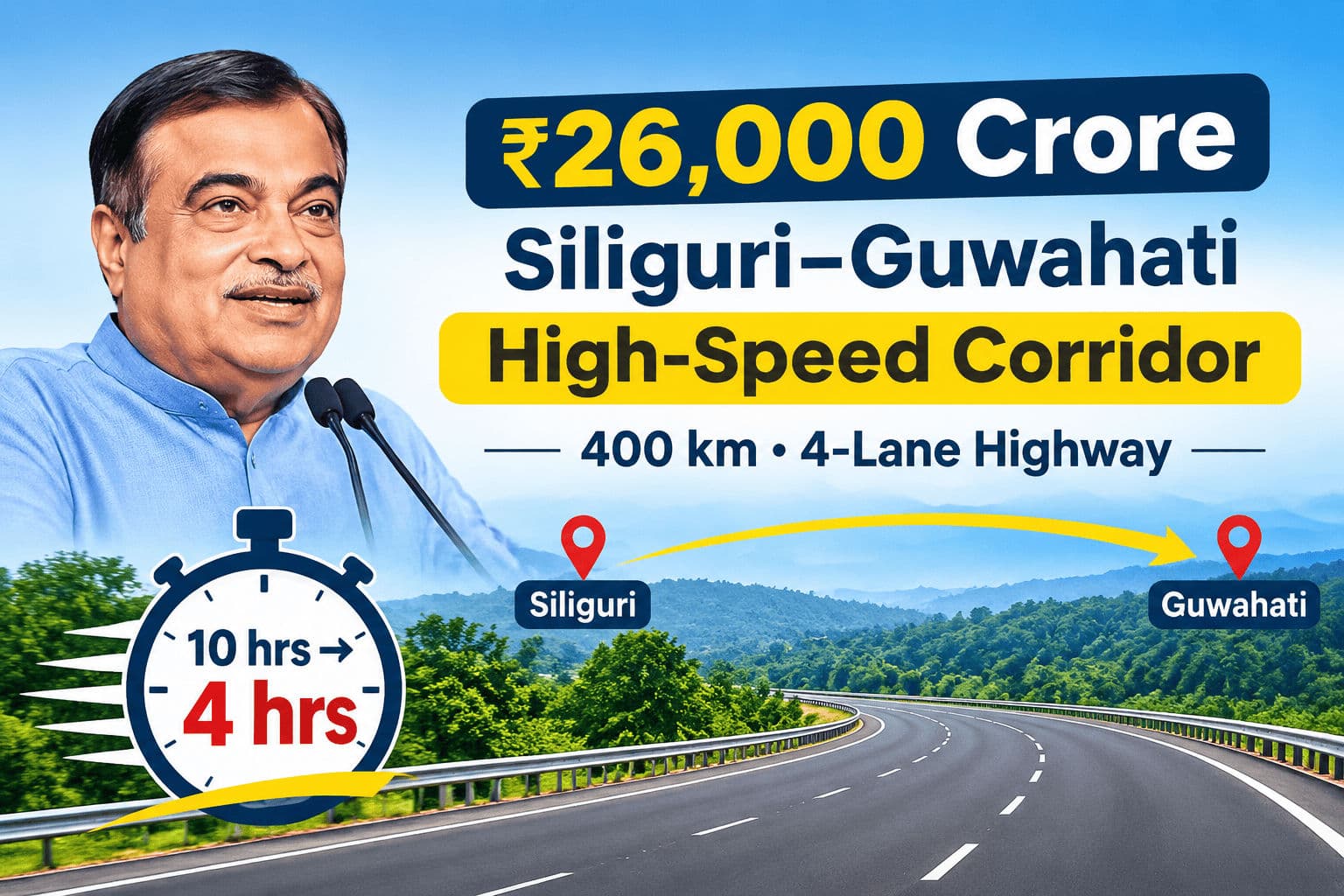
Direct answer: Union Minister Nitin Gadkari has announced a proposed ₹26,000 crore, 400-km four-lane high-speed corridor between Siliguri and Guwahati — a highway designed to slash the journey from about 10 hours today to roughly 4 hours. This is a genuinely strategic project: it links North Bengal's gateway city with the gateway to the entire Northeast. Crucially, it's among the more advanced proposals in the region's highway push — its Detailed Project Report (DPR) is already complete, and efforts are reportedly being made to begin work during the current year. The exact intermediate alignment hasn't been made public yet. Here's the complete, focused breakdown.
⚡ Quick Facts — The Siliguri–Guwahati Corridor
Item | Detail |
|---|---|
Project | Siliguri–Guwahati high-speed corridor |
Length | 400 km |
Cost | ₹26,000 crore |
Type | Four-lane high-speed corridor |
Travel time | ~10 hours → ~4 hours |
Announced by | Union Minister Nitin Gadkari (NHAI event, Kolaghat, WB) |
DPR status | Complete |
Work start | Efforts to begin during the current year |
Route detail | Endpoints confirmed (Siliguri–Guwahati); intermediate alignment not yet public |
1️⃣ The ₹26,000 Crore Investment — Scope & Announcement
At an NHAI programme in Kolaghat, West Bengal, Union Road Transport & Highways Minister Nitin Gadkari announced a ₹26,000 crore high-speed corridor linking Siliguri and Guwahati. At 400 km and ₹26,000 crore, this is one of the largest and most strategically important projects in a sweeping highway push for Bengal and the Northeast.
The scope is ambitious by design: not a patchwork of upgrades, but a dedicated high-speed, four-lane corridor built to move people and goods between North Bengal and Assam far faster than today's roads allow.
2️⃣ The 400-km Four-Lane Corridor — Route & Connectivity
The project is a 400-km, four-lane high-speed corridor, connecting:
Siliguri — North Bengal's gateway city and the hub for the hills, Sikkim, Nepal, Bhutan and Bangladesh trade routes, and
Guwahati — the largest city of the Northeast and its principal commercial and transport gateway.
A quick, useful clarification of the terms:
"High-speed corridor" means a highway engineered for faster, uninterrupted travel — with design features (controlled access, better geometry) that allow higher sustained speeds than ordinary highways.
Only the two endpoints are confirmed so far; the detailed intermediate alignment and interchange points haven't been made public, and will be defined as the project advances.
Today, the Siliguri–Guwahati journey runs largely along the existing East–West corridor (NH-27) through North Bengal and lower Assam — a long, often congested haul that this corridor aims to transform.
3️⃣ DPR Completed — Why That Matters
This is a key signal of seriousness. The Detailed Project Report (DPR) for the Siliguri–Guwahati corridor is complete — a major milestone, because the DPR is the document that:
Defines the alignment, engineering design and technical feasibility,
Establishes the cost estimate and land requirements, and
Forms the basis for sanction, tendering and construction.
A completed DPR moves a project firmly from "idea" to "ready-to-advance" — and sets up the next stages of approval and execution. Among the region's newly announced corridors, this places Siliguri–Guwahati ahead of several others that are still at the DPR-preparation stage.
4️⃣ Travel Time: From ~10 Hours to ~4 Hours
The headline benefit is dramatic: cutting the Siliguri–Guwahati journey from around 10 hours to approximately 4 hours.
Why that's a game-changer:
⏱️ Roughly six hours saved, each way — a transformational gain for a route this heavily used.
🚚 Faster freight — goods move between North Bengal and the Northeast far more quickly and cheaply.
🧭 Reliability — a high-speed, four-lane corridor offers predictable travel, unlike today's congested mixed-traffic roads.
🛡️ Safety — modern corridor design reduces the risks of long-haul travel.
Halving-and-more the travel time effectively redraws the economic map between North Bengal and Assam.
5️⃣ North Bengal–Northeast Connectivity: The Strategic Picture
This is where the project's real significance lies. Siliguri sits on the "Siliguri Corridor" — the narrow strip of land (often called the "Chicken's Neck") that connects mainland India to the eight Northeastern states. Guwahati is the Northeast's biggest city and commercial gateway.
A fast, high-capacity Siliguri–Guwahati corridor therefore:
Strengthens India's link to the entire Northeast — a region of growing economic and strategic importance.
Reinforces Siliguri as the pivot — the logistics, trade and transit hub between the rest of India, the Northeast, and neighbouring countries.
Boosts resilience — better, faster road links add redundancy and reliability to a strategically vital corridor.
Few road projects carry this level of national strategic weight alongside everyday economic benefit.
6️⃣ Trade, Logistics & Tourism
The economic ripple effects are broad:
🚛 Trade & logistics — faster, cheaper movement of goods between the Northeast, North Bengal and the rest of India; a major boost for supply chains, warehousing and distribution (Siliguri is already a key distribution hub).
🏭 Business & industry — improved connectivity attracts investment and supports manufacturing, agro-processing and services along the corridor.
🧳 Tourism — easier access opens up both North Bengal (hills, Dooars, Sikkim) and the Northeast's rich tourism circuits to more travellers.
🏙️ Siliguri's momentum — stacked with the Bagdogra airport expansion, NH-327 four-laning and the parallel Siliguri–Sikkim and Siliguri–Darjeeling projects, this cements Siliguri as North Bengal's economic engine. See
Siliguri's Best Localities to Invest In and the GFS North Bengal Real Estate 2026: Complete Guide.
7️⃣ Construction Timeline & Execution — Where It Stands
The honest, current status:
✅ DPR complete — the project is technically defined and ready to advance.
🏗️ Work start: Efforts are reportedly being made to begin during the current year — a strong signal of intent, though a firm start date hasn't been formally confirmed.
🗺️ Alignment: The detailed route and interchange points are not yet public.
⏳ Completion: No completion date has been announced; a 400-km corridor is a multi-year build.
The bigger picture: Siliguri–Guwahati is one of several corridors in a transformative North Bengal and Bengal highway push — alongside the ₹6,000 crore Siliguri–Sikkim four-lane highway, the ₹6,000 crore Siliguri–Darjeeling greenfield road, the Gorakhpur–Siliguri expressway (₹38,000 cr), and more. Explore the companions: ₹6,000 Crore Siliguri–Sikkim Highway and ₹6,000 Crore Siliguri–Darjeeling Greenfield Road, and track it all in the North Bengal Infrastructure Tracker.
⚖️ An Honest Note
A realistic lens:
Announced & DPR-ready — a meaningful, advanced stage, but full sanction, tendering and construction still lie ahead.
"Current year" is intent, not a guarantee — a firm, formally confirmed start date hasn't been announced.
Big corridors take years — 400 km of high-speed highway is a multi-year undertaking, and details can evolve.
The direction and the completed DPR are genuinely encouraging — but follow the project's milestones rather than treating the 4-hour journey as imminent.
🔑 Key Takeaways
🛣️ A proposed ₹26,000 crore, 400-km four-lane Siliguri–Guwahati high-speed corridor has been announced by Union Minister Nitin Gadkari.
⏱️ Travel could fall from ~10 hours to ~4 hours — roughly six hours saved each way.
✅ The DPR is complete — a major milestone — with efforts to start work during the current year.
🧭 Strategically vital — it links North Bengal to the gateway of the entire Northeast via the Siliguri Corridor ("Chicken's Neck").
🚚 Huge for trade & logistics — faster, cheaper freight between the Northeast, North Bengal and the rest of India.
🧳 Tourism & business gain — opening up hill, Dooars and Northeast circuits, and boosting Siliguri's hub role.
⚖️ Advanced proposal — DPR-ready, but sanction, alignment and construction timeline are still to be confirmed.
👤 About the Author
Written by the Siliguri Properties Team — a hyperlocal resource for Siliguri & North Bengal, turning major infrastructure announcements into clear, useful insights for residents, businesses, travellers and investors.
📚 Related Reads
₹6,000 Crore Siliguri–Sikkim Highway: 52-km Road with Tunnels & Viaducts
₹6,000 Crore Siliguri–Darjeeling Greenfield Road: 77-km New Highway
Adani Group Eyes the Darjeeling–Kurseong Ropeway: Tourism, Infrastructure & Real Estate
₹192.65 Crore NH-10 Slope Protection Project: Safer Sevoke–Rangpo Connectivity
Siliguri's Infrastructure Revolution: What's Changing & Why It Matters
Siliguri's Best Localities to Invest In: A Data-Driven Ranking
🏡 As the Northeast Comes Closer, Siliguri Leads
A 4-hour Siliguri–Guwahati corridor would reshape trade, travel and opportunity across eastern India — and Siliguri, the strategic gateway, sits at the very centre of it. Understanding this momentum early is the smart move.
👉 Explore land, plots, flats & commercial opportunities across Siliguri & North Bengal on SiliguriProperties.com and GFS Realtors.
📞 Talk to GFS Realtors — Sanat Trade Center, 1st Floor, Sevoke Road, Siliguri-01. Call +91 99320 66666. With 20+ years in North Bengal's market, we help you read the region's momentum and make well-verified property decisions.
This article is general informational content based on reported statements about the proposed ₹26,000 crore, 400-km four-lane Siliguri–Guwahati high-speed corridor announced by Union Minister Nitin Gadkari, for awareness purposes only. The project's DPR is reported complete, with efforts to begin work during the current year; however, the detailed alignment, formal construction start and completion timeline have not been officially confirmed and are subject to change. Travel-time estimates are as reported. This is not investment or legal advice. Please verify current project details with official sources, and consult a qualified professional before making any property or travel decisions.