West Bengal’s New Land Pooling Model 2026: 20–25% Developed Land for Farmers, Monetary Compensation & A New Approach to Industrial Development

GFS Realtors
We provide deep market insights and strategic advice for real estate buyers, sellers, and investors.
Expert at providing deep market insights and strategic advice for real estate
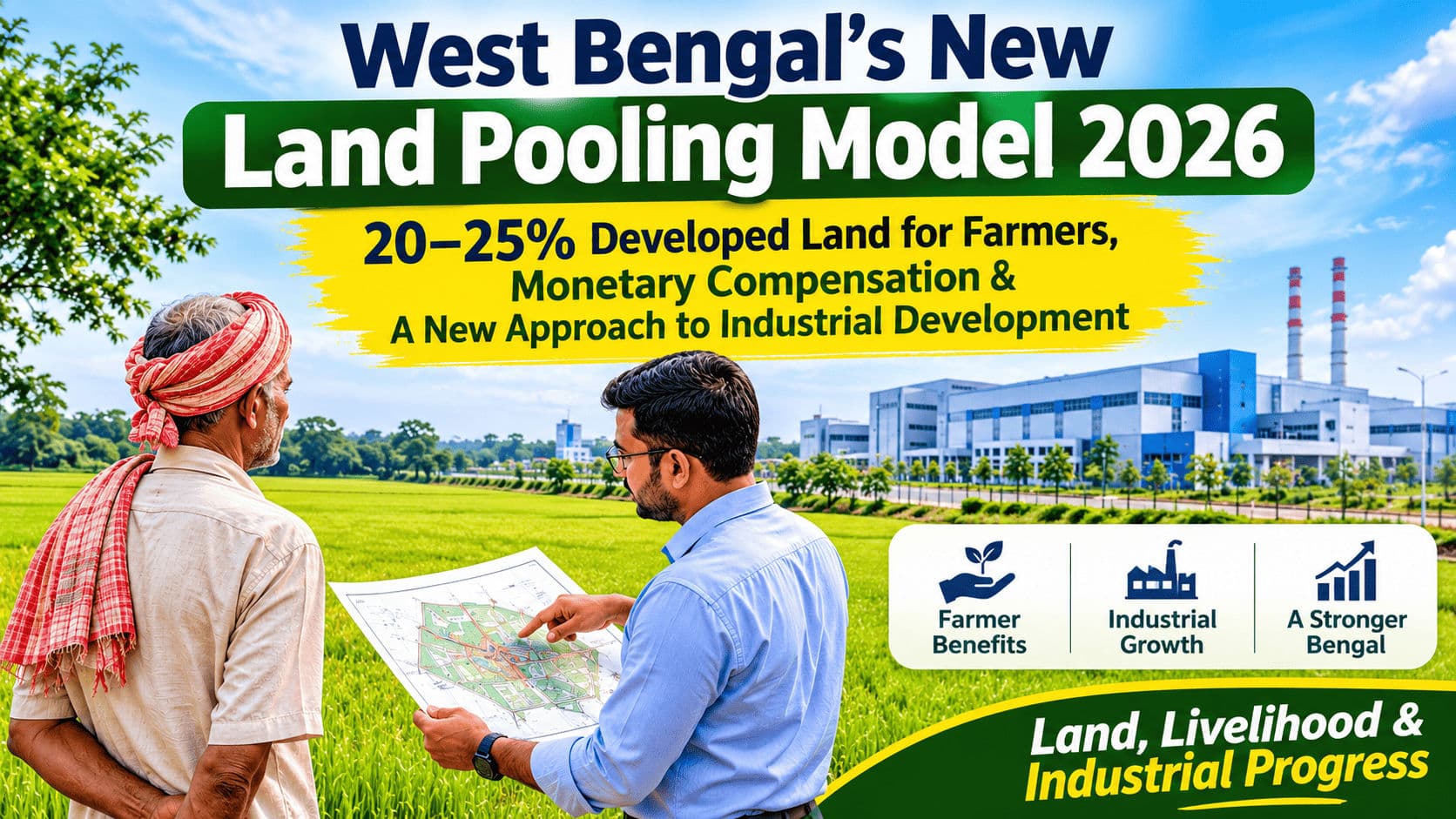
West Bengal’s New Land Pooling Model 2026: 20–25% Developed Land for Farmers, Monetary Compensation & A New Approach to Industrial Development
A new chapter in Bengal’s land and industrial policy: understanding how farmers could benefit from land pooling while creating new opportunities for industrial growth and investment.
Direct answer: For nearly two decades, one word has defined West Bengal’s struggle to industrialise: land. The Singur and Nandigram agitations of the late 2000s made forcible land acquisition politically untouchable in Bengal — and investment suffered for it. Now, the state government is weighing a fundamentally different, consent-based approach: a land pooling model under which farmers and landowners would voluntarily contribute land, and in return receive 20–25% of the developed land back, plus monetary compensation — and, in some versions, equity in the industries built on it. No forcible acquisition. This blog explains how the model would work, what farmers could gain, the industrial opportunity it could unlock, and — importantly — the honest challenges that stand in the way.
Quick Facts — The Proposed Model
Item | Detail |
|---|---|
What | A land pooling model to secure land for industry |
Farmer’s share | 20–25% of developed land returned (some reports: 25–30%) |
Plus | Monetary compensation, and potentially equity/shares in the industry |
Core principle | No forcible acquisition (lessons of Singur & Nandigram) |
Problem it solves | Fragmented, small landholdings that are hard to assemble |
Land sources examined | Existing land banks (e.g., Raghunathpur, Haringhata, Kalyani), idle industrial plots, >5,000 acres of unused central PSU land |
Investment target | ₹1 lakh crore in the coming months |
Status | Under consideration; would need new legislation |
A note on the numbers: the headline figure is a 20–25% developed-land share; some reports cite 25–30%, in line with states like Haryana, Gujarat and Telangana (20–30%). The exact terms are still being worked out — treat this as a model under discussion, not a finalised law.
Why This Is Historically Significant
To understand why this matters, you have to understand Bengal’s past. The state’s industrial ambitions were derailed by the Singur (Tata Nano) and Nandigram land conflicts, where forcible acquisition of farmland triggered mass protests that reshaped Bengal politics. Ever since, acquiring large, contiguous land for industry has been the single hardest problem in the state — investors stayed away precisely because land couldn’t be assembled without conflict.
The CM has explicitly ruled out forcible acquisition, citing the lessons of Singur and Nandigram. That’s what makes land pooling so significant: it’s an attempt to break the 20-year deadlock by making farmers partners in development rather than displaced parties. If it works, it could change Bengal’s entire industrial trajectory.
First, What Is Land Pooling? (And How It Differs From Land Acquisition)
This is the core concept — get this, and the whole policy makes sense.
Land Acquisition (old way) | Land Pooling (new model) | |
|---|---|---|
How land is taken | Government compulsorily acquires it | Farmers voluntarily contribute it |
What the farmer gets | One-time cash compensation | A share of the developed land + compensation (± equity) |
Farmer’s role | Displaced seller | Partner / stakeholder |
Upside for farmer | None after the payout | Gains from the rising value of developed land |
Consent | Often contested | Built on participation |
Here’s the key insight: under pooling, a farmer gives up, say, 1 acre of raw agricultural land and gets back a smaller plot (20–25%) of fully developed, infrastructure-ready land — which can be worth far more per unit than the raw land they contributed, plus cash. The farmer keeps a stake in the upside instead of being cashed out and left behind.
How the Proposed Bengal Model Would Work
Based on how pooling operates (and on the reported Bengal proposal), the mechanism looks like this:
Farmers pool their land — often by forming a company or collective and transferring their fragmented plots into it.
The land is aggregated into a large, contiguous parcel suitable for industry.
The land is developed — roads, drainage, power, utilities and common infrastructure are added (by the state and/or a private developer).
A share is returned to farmers — 20–25% of the now-developed, higher-value land goes back to the original owners.
Farmers also receive compensation — a monetary package, and in some models, equity/shares in the industry built on the pooled land.
Industry gets ready-to-use land — clean, assembled, infrastructure-ready plots, without the conflict of forced acquisition.
Everyone, in theory, wins: farmers get land plus money plus upside; industry gets usable land; the state gets investment and jobs.
What Farmers Could Gain
This is the heart of the model’s appeal:
A developed-land share (20–25%) — smaller in size than what they contributed, but potentially far higher in value once serviced with infrastructure.
Monetary compensation — a cash component alongside the land.
Potential equity — a continuing stake in the industry’s success, in some versions.
No displacement without consent — participation, not coercion.
Long-term value — proximity to a new industrial hub can lift the value and usability of the returned plots over time.
The promise is that a farmer isn’t just paid once and forgotten, but becomes a long-term beneficiary of the development their land makes possible.
Why Bengal Specifically Needs a New Approach
The numbers explain the urgency:
Population density of ~1,127 people per sq km — nearly three times the national average (~400).
Average operational landholding of just 0.77 hectares — land is highly fragmented among many small owners.
Fertile, densely-farmed land — making large, conflict-free assembly genuinely difficult.
In a state this dense and fragmented, the old “acquire big blocks” model simply doesn’t fit. Pooling — assembling many small parcels with their owners’ buy-in — is arguably the only realistic path. This connects directly to the land-reform momentum we covered in West Bengal to Scrap the Urban Land Ceiling Act and the GFS West Bengal Real Estate Reforms 2026.
The Industrial Opportunity
The pooling model is one pillar of a broader industrial push aiming at ₹1 lakh crore in investment in the coming months. The state is simultaneously examining multiple land sources:
Existing industrial land banks — including names like Raghunathpur, Haringhata and Kalyani.
Recovering idle industrial plots allotted but never developed.
Over 5,000 acres of unused central PSU land.
A GIS-based land inventory to map available land digitally.
Funding tie-ups reportedly explored with HUDCO, NABARD and the Asian Development Bank.
Together with the new incentive framework, this signals a serious intent to make land — Bengal’s historic bottleneck — available for industry at last.
Proven Elsewhere: The Precedents
Land pooling isn’t untested — it’s how several states have unlocked large-scale development:
Andhra Pradesh (Amaravati): ~33,000 acres pooled from ~29,000 farmers to build a new capital — one of India’s largest pooling exercises.
Gujarat, Haryana & Telangana: farmers receive 20–30% of developed land, depending on the state.
These show the model can work at scale — while also reminding us it takes careful execution, trust and time.
The Honest Challenges (Why This Won’t Be Easy)
A credible analysis has to be balanced — and this policy faces real hurdles:
It needs new legislation. Existing land laws are under review; a pooling framework requires a fresh legal basis.
Trust must be rebuilt. After Singur and Nandigram, farmer confidence in any land scheme is fragile.
Model-fit doubts. Economists warn that pooling models from Haryana, Andhra Pradesh or UP may not transfer cleanly to Bengal’s uniquely dense, small-holding landscape.
Tribal & environmental concerns. Tribal organisations have protested (e.g., in Purulia) over land, forest and water rights, and there are environmental concerns around specific projects.
Sharecropper (bargadar) rights. Bengal’s legacy of recorded sharecroppers raises the question of who counts as a landholder entitled to a share.
Political scrutiny. Critics have called the approach a “rehash” of earlier policy, demanding a more fundamental rethink.
The fiscal backdrop. With a large state debt and a reported ~₹50,000 crore incentive backlog, delivery will be tested.
None of these are reasons to dismiss the model — but they’re the reasons it must be designed and implemented carefully to succeed.
What It Could Mean for North Bengal & Siliguri
Honestly stated: the land banks currently named (Raghunathpur, Haringhata, Kalyani) are in southern Bengal, and the immediate industrial focus is there. But the pooling model, if adopted as state policy, becomes a tool for the whole state — including North Bengal, where land is just as fragmented and land assembly is a real constraint on industrial and large-format development.
For Siliguri — North Bengal’s industrial and logistics hub — a workable, consent-based way to assemble land could, over time, help unlock industrial parks, warehousing and organised development on the gateway corridors. That’s a long-term possibility, not a present reality, and it would sit alongside the region’s other enablers covered in our North Bengal Infrastructure Tracker, Investing in Big-Size Land in Siliguri and Industrial & Warehousing Land Investment in Siliguri.
🔑 Key Takeaways
🌾 Bengal is weighing a land pooling model — farmers get 20–25% of developed land back, plus compensation (and possibly equity).
🤝 Consent, not coercion — a direct response to the Singur/Nandigram legacy; no forcible acquisition.
🔑 Pooling vs acquisition — farmers become partners in rising land value, not cashed-out sellers.
🏭 Part of a ₹1 lakh crore industrial push — alongside land banks, idle-plot recovery and a GIS land inventory.
🌍 Proven elsewhere — Amaravati, Gujarat, Haryana, Telangana (20–30% farmer share).
⚠️ Real challenges remain — new legislation, trust, tribal/environmental concerns, sharecropper rights, model-fit doubts.
🧭 North Bengal relevance is longer-term — the model, if adopted statewide, could help assemble land around Siliguri in future.
👤 About the Author
Written by the Siliguri Properties Team — a hyperlocal resource for Siliguri & North Bengal, tracking the land, policy and industrial developments shaping the region’s economy and future.
📚 Related Reads (Understand the Full Picture)
West Bengal to Scrap the Urban Land Ceiling Act: What It Unlocks
Investing in Big-Size Land in Siliguri: Industrial, Warehouse & Institutional Corridors
Why Siliguri Is North Bengal’s #1 Real Estate Investment Destination
The Complete 2026 Roadmap to Investing in Siliguri Property (GFS)
📌 Stay Informed on Bengal’s Land & Industrial Policy
Land policy shapes everything downstream — industry, jobs, and property. For clear, balanced updates on Bengal’s land and development landscape, and grounded property guidance:
👉 Follow SiliguriProperties.com and GFS Realtors.
📞 Talk to GFS Realtors — Sanat Trade Center, 1st Floor, Sevoke Road, Siliguri-01. Call +91 99320 66666. With 20+ years in North Bengal’s land and property market, we help you understand how policy shifts affect land — and verify every property end-to-end before you commit.
This article is general information based on reported discussions of West Bengal’s proposed land pooling model (including Economic Times reporting, November 2026) and related coverage, for understanding only — not investment, legal or financial advice. The model is under consideration, would require new legislation, and its terms (including the exact developed-land share and compensation) are not finalised and may change. Figures and details are as reported. Always verify land status and policy with official sources and a qualified professional before making decisions.